Why the Offside Line Moves with the Play
Understand why the offside line moves with the play and judge a forward’s position against the ball and second-last opponent at the instant of a pass.
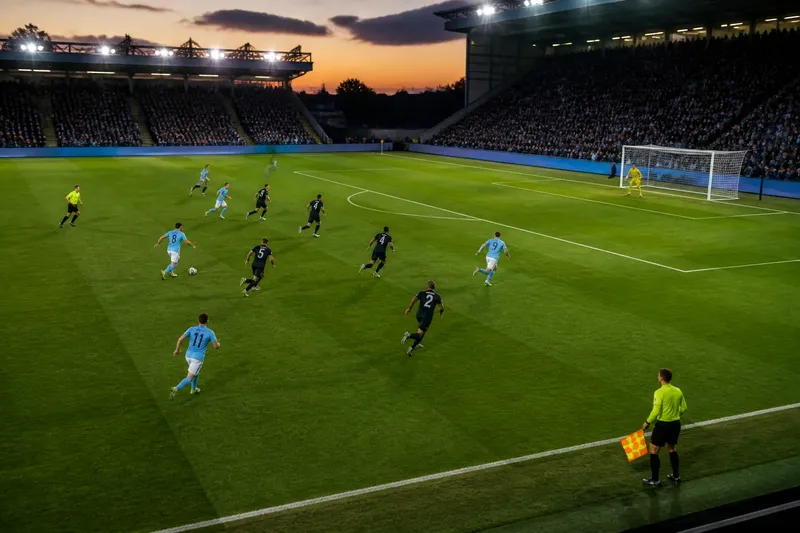
The offside line moves with the play because a player’s position is judged when a teammate plays or touches the ball, not when the pass arrives. To read the decision, compare the attacker with both the ball and the second-last opponent at that instant. The line is not painted across the grass; it is a changing reference point.
Start with the pass
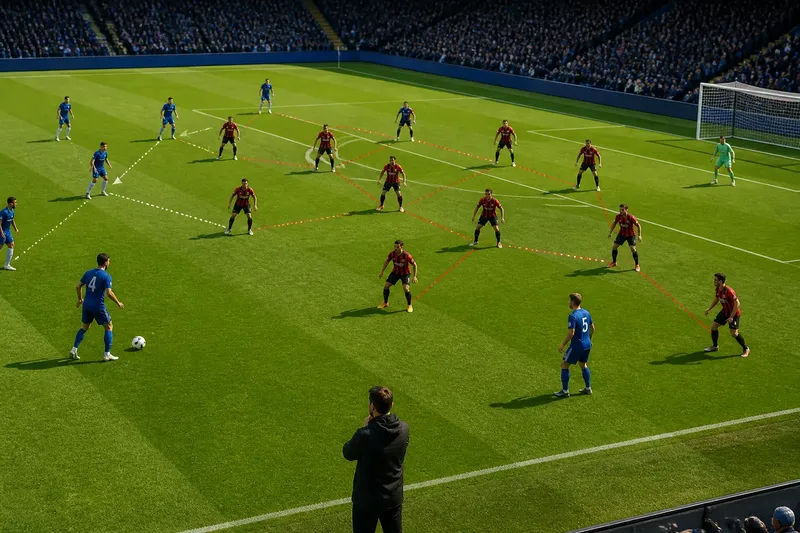
Suppose a midfielder has the ball and a forward is waiting beyond the defenders. The forward’s position alone does not settle the question. The assistant referee judges where the forward is when the midfielder plays or touches the ball, then whether the forward becomes involved in active play.
The moment of the teammate’s touch matters. A forward can be onside while a teammate carries the ball, then move beyond the relevant line before the pass. If the teammate releases it after that movement, the forward’s position is assessed at release. Conversely, a forward who starts beyond the line but moves back onside before the teammate plays the ball is judged by their position at that touch.
Think of the line like the edge of a shadow cast by the ball and the opponents: it shifts as those reference points shift, and a player’s earlier location does not freeze it in place. The analogy is only a way to picture a moving boundary; the actual judgement comes from the positions on the pitch at the key moment.
Read the two comparisons
At the instant a teammate plays the ball, first compare the attacker with the ball. Then compare the attacker with the second-last opponent. For an attacker to be in an offside position, they must be in the opponents’ half and nearer to the opponents’ goal line than both the ball and the second-last opponent.
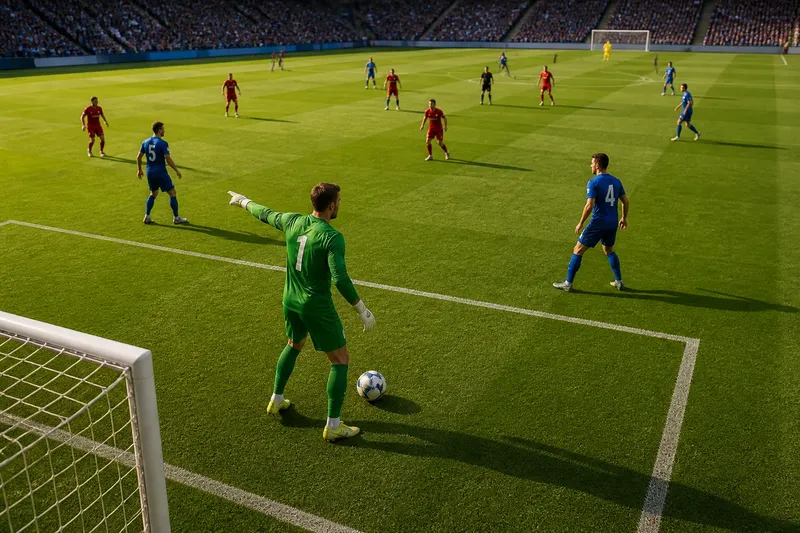
The second-last opponent is not automatically the last outfield defender. The goalkeeper counts as an opponent too, so the relevant pair may be the goalkeeper and one defender, or two outfield players if the goalkeeper has moved away from goal. The judgement concerns the opponents’ positions relative to the goal line, not their job titles.
If the attacker is level with the second-last opponent, or level with the ball, they are not in an offside position. For this comparison, count the head, body or feet if that part can legally play the ball; arms and hands do not count. The relevant parts are those that can legally score a goal, as specified by the Laws of the Game.
Being in an offside position is not, by itself, an offence. The player must then become involved in active play, such as playing or touching the ball, interfering with an opponent, or gaining an advantage from a rebound or deflection. This is why the assistant referee may keep the flag down until the involvement becomes clear.
Choose the situation
Which comparison fits depends on the positions at the moment the ball is played. Use the situation that matches that moment rather than trying to follow an imagined fixed line.
- The ball is level with or ahead of the attacker. Check whether the ball is at least as close to the goal line as the attacker. If it is, the attacker is not in an offside position; if it is behind the attacker, compare the attacker with the second-last opponent as well.
- The attacker is behind the second-last opponent. Check their position against that opponent. If the attacker is level with or behind them, they are not in an offside position; if they are nearer the goal line, compare with the ball and confirm they are in the opponents’ half.
- The attacker is ahead of both the ball and the second-last opponent. Check that the attacker is in the opponents’ half. If so, they are in an offside position and the next decision is whether they become involved; if not, there is no offside position.
- The attacker is level with either reference point. Check the attacker’s position at the instant of the teammate’s play. If level with the ball or second-last opponent, they are not in an offside position; if clearly nearer the goal line than both, apply the remaining parts of the test.
- The attacker is in their own half. Check which side of halfway they occupy at the moment of the teammate’s play. If they are in their own half, they cannot be in an offside position; if they are in the opponents’ half, compare them with the ball and second-last opponent.
- The goalkeeper has left the goal area. Check the positions of all opponents relative to the goal line and identify the second-last one. If the goalkeeper is not among the two closest, use two outfield opponents; if the goalkeeper is among them, include the goalkeeper in the comparison.
Say a midfielder is carrying the ball towards goal while a forward runs ahead of the defensive line. The forward is level with the ball when the midfielder releases a pass, so there is no offside position at that instant. If the midfielder takes another touch before passing and the forward is then beyond both the ball and the second-last opponent in the opponents’ half, the forward is in an offside position; if they play the ball, an offside offence follows.
The example turns on the changing positions, not the forward’s speed or where the run began. To follow a close passage, watch the passer’s foot make contact, then compare the attacker with the ball and the second-last opponent at that instant. Next, watch whether the attacker becomes involved.
When does the line shift?
Does the line follow the last defender?
No. It is set by the second-last opponent, and the goalkeeper may be one of the two opponents closest to the goal line. If the goalkeeper comes out, the relevant opponents can change even when the outfield defensive line appears unchanged.
Can an attacker be offside without touching the ball?
Yes, if a player in an offside position interferes with an opponent, for example by obstructing an opponent’s ability to play the ball. Simply standing in an offside position is not enough; the player must become involved in a way covered by the law.
What if the ball rebounds to the attacker?
An attacker who was in an offside position when a teammate played the ball may be penalised for gaining an advantage by playing a rebound or deflection. A deliberate play by an opponent can affect the judgement differently, but the distinction depends on the action involved.
Does every forward pass create offside?
No. The direction of the pass is not the test. A pass played backwards can still lead to an offside offence if a teammate was in an offside position when the ball was played and then becomes involved; a forward pass can be onside if the attacker meets the position test.
Separate position from offence
Two questions keep the rule clear. First, was the attacker in an offside position when a teammate played the ball? Second, did the attacker then become involved in active play? Answering only the first question can make an ordinary run look illegal when the player never challenges for the ball or affects an opponent.
Also distinguish a teammate’s deliberate play from an opponent’s action. An attacker is not penalised for receiving the ball directly from a goal kick, corner kick or throw-in. If an opponent deliberately plays the ball, the offside assessment may be reset, unless the action is a deliberate save. These situations turn on the nature of the play, rather than simply on which direction the ball travelled.
For a close decision, the assistant referee’s view and the applicable competition procedures matter. The Laws of the Game and the competition’s officiating arrangements determine how a particular incident is handled; this explanation covers the basic positional test rather than judging footage from a specific match.
Watch the right moment
When the next through-ball is played, do not freeze the defenders’ line in your mind or judge the forward by where they end up. Find the instant of the teammate’s play, compare the attacker with the ball and the second-last opponent, then watch for involvement. That sequence explains why the offside line moves with the play—and why the same run can be legal at one touch and penalised at the next.